
Chinese Official Mahjong (Guobiao) Rules for Beginners
Sep 25, 2026 · 6 min read
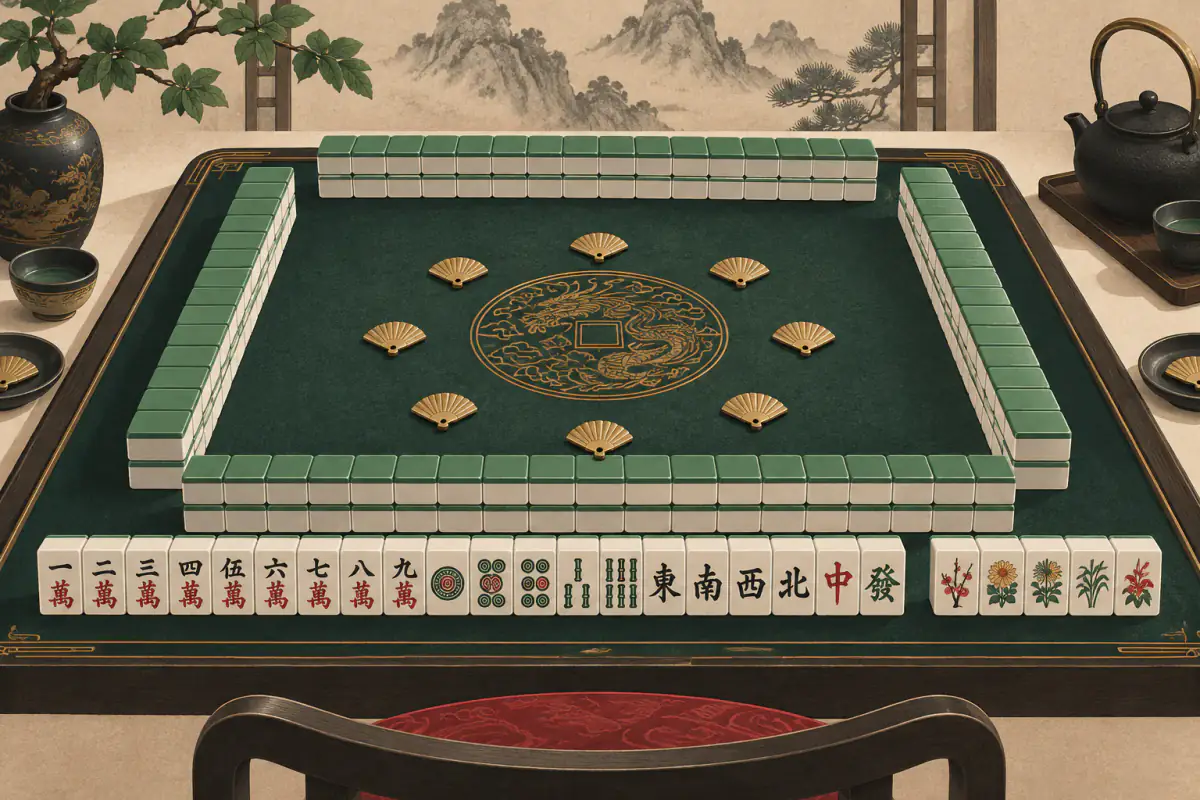
Chinese Official Mahjong (officially called Guobiao, or Mahjong Competition Rules) is a ruleset standardized by the Chinese government in 1998, and is now the standard at international tournaments like the World Series of Mahjong.
Hand Structure
Just like Riichi, a standard hand is still 4 sets + 1 pair. The difference is there's no riichi or dora concept at all -- all value comes purely from patterns (called fan) that are fulfilled.
The Fan System
There are over 80 different fan patterns in the official rules, ranging from 1-fan patterns (e.g. Concealed Hand) up to 88 fan (Big Four Winds). The final score is calculated directly from total fan with no fu component at all -- far simpler mathematically than Riichi.
The Minimum Requirement to Win
You need at least 8 fan to be able to win -- a much higher bar than Riichi, where any single yaku suffices. This means Chinese Official players really need to memorize which pattern combinations complement each other.
A Real Example of Reaching 8 Fan
Say your hand is fully closed, wins via Tsumo, every set is a sequence/pair from tiles 2-8 (no terminals/honors), and you have 2 closed triplets. The fan combination:
| Pattern Satisfied | Fan |
|---|---|
| Concealed Hand (closed + won via Tsumo) | 2 |
| All Simples (every tile 2-8) | 2 |
| Two Concealed Triplets | 2 |
| Self-Drawn (extra bonus for tsumo) | 1 |
| Another small pattern that often comes along naturally | 1 |
| Total | 8 |
Combinations like this are why 8 fan feels realistic to reach without needing one rare, high-value pattern -- just stacking a few small, complementary patterns that a genuinely good hand shape already tends to satisfy.
Compare it with the Riichi scoring system you may already know.
Read the Scoring Comparison →