
A Glossary of Common Mahjong Terms
Sep 24, 2026 · 7 min read
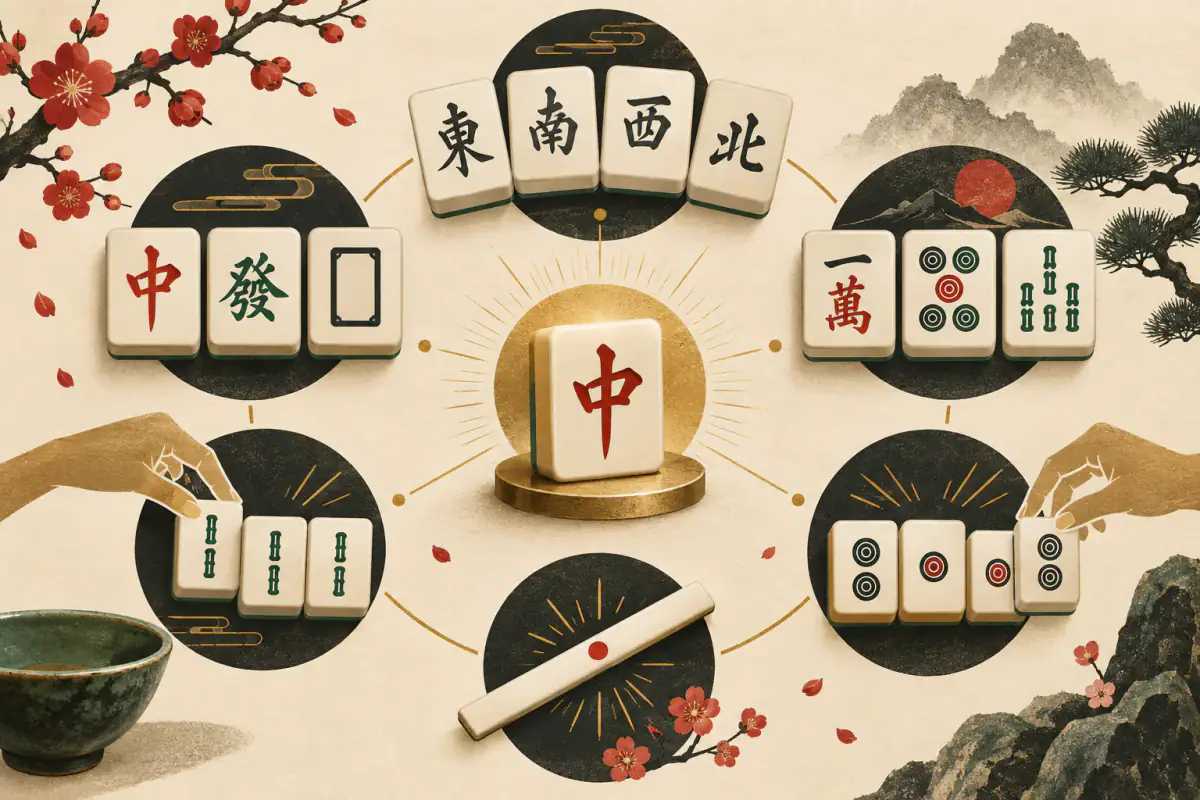
Mahjong has a lot of specialized terms (mostly Japanese for Riichi Mahjong) that can confuse beginners. Here's a collection of 24 of the most frequently used terms, grouped by difficulty level.
Basic Terms
| Term | Meaning |
|---|---|
| Tenpai | A hand one tile away from winning. |
| Noten | A hand still needing 2+ tiles, the opposite of tenpai. |
| Ron | Winning by claiming an opponent's discard. |
| Tsumo | Winning by drawing your own tile. |
| Shanten | The minimum number of tile swaps needed to reach tenpai. |
| Hanchan | One full East + South round rotation, the common unit for one play session. |
Intermediate Terms
| Term | Meaning |
|---|---|
| Furiten | A condition barring Ron because you've discarded a tile you're waiting on. |
| Riichi | Declaring a closed tenpai hand with a 1000-point bet. |
| Dora | A bonus tile adding han, determined from an indicator tile. |
| Menzen | The status of a closed hand (no open Pon/Chi/Kan). |
| Fu and Han | The two base components of Riichi score calculation. |
| Honba | A counter for dealer continuation, adding a bonus to every subsequent win. |
Advanced Terms
| Term | Meaning |
|---|---|
| Ippatsu | A bonus for winning within one go-around after riichi with no interruption. |
| Suji | A statistical pattern that helps judge how safe a tile is. |
| Genbutsu | A tile already proven safe to discard. |
| Yakuman | A maximum-value hand, roughly equivalent to 13 han. |
| Ryuukyoku | A hand ending in a draw because the wall ran out. |
| Kabe | "Wall" -- when all four copies of a tile have been seen, making waits around it easier to read. |
More Terms You'll Run Into
| Term | Meaning |
|---|---|
| Kawa | A player's row of discarded tiles, read to judge an opponent's chances. |
| Oriru | To fold -- deliberately not chasing your own win for safety. |
| Rinshan | The replacement tile drawn after a Kan; winning off it is called Rinshan Kaihou. |
| Chombo | A penalty for a serious mistake (e.g. falsely declaring a win), usually a point fine. |
| Renchan | The dealer staying in their seat for the next hand. |
| Tobi | A rule ending a session instantly if a player's score goes negative. |
You don't need to memorize all of it at once -- learn the "Basic" column first while playing, then gradually work up to the intermediate and advanced terms as your experience grows.
Dig deeper into these terms via the basic Riichi rules article.
Read the Basic Riichi Rules →