
The History of Mahjong: From 19th-Century China to a Global Game
Sep 24, 2026 · 6 min read
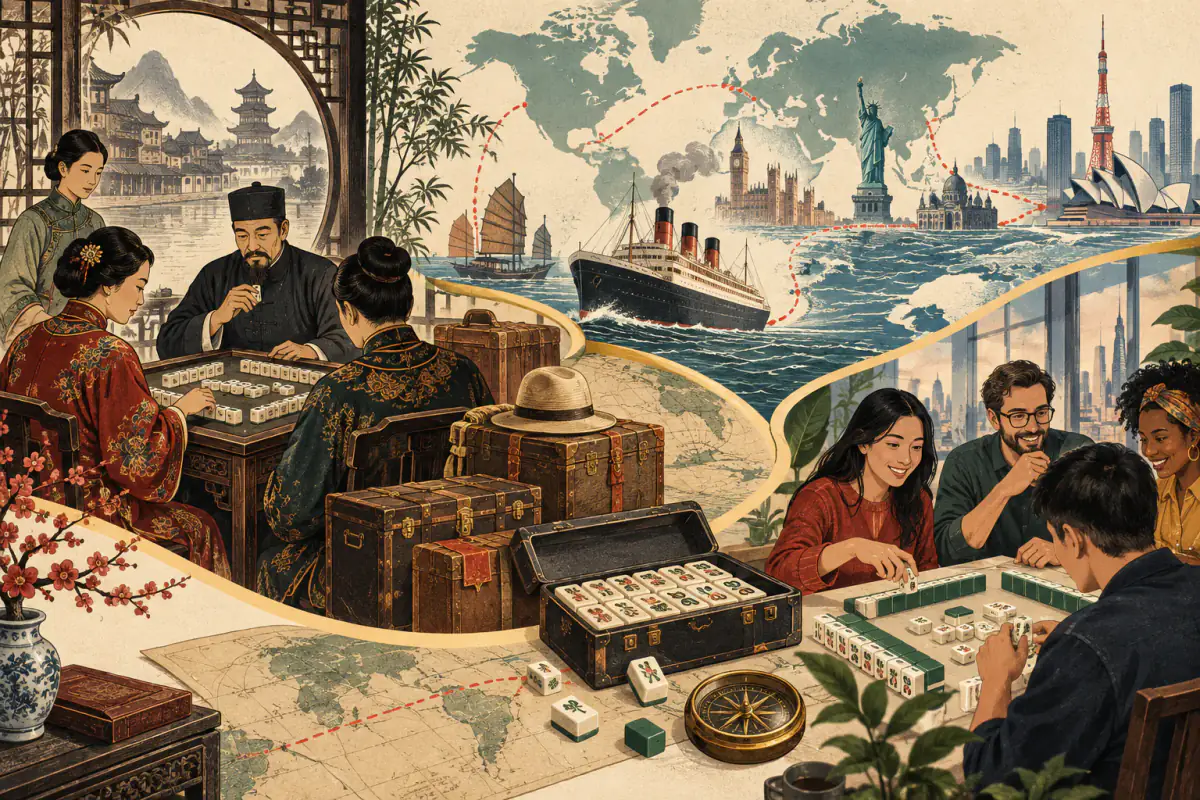
Mahjong is believed to have originated around the Shanghai and Ningbo regions of China in the mid-19th century, evolving from older Chinese domino card games like Madiao (which dates back to the Ming Dynasty) and the card game Khanhoo.
| Year | Event |
|---|---|
| ~1850s | Mahjong begins taking shape around Shanghai, evolving from Madiao and Khanhoo. |
| 1895 | The first known Western written account of mahjong, from an American missionary in China. |
| 1920 | Joseph Park Babcock publishes a simplified mahjong rulebook for Western markets, sparking mass import to the US. |
| 1923-1924 | The "mahjong craze" sweeps the United States -- mahjong set sales briefly outpaced many popular toys of the time. |
| 1937 | The National Mah Jongg League (NMJL) is founded in the US, standardizing American Mahjong and its annual card. |
| Early 1900s | Riichi Mahjong begins forming in Japan, blending Chinese rules with new concepts (riichi, dora). |
| 1952 | The Japan Mahjong Association is founded, further pushing Riichi Mahjong standardization. |
| 1998 | Chinese Official Mahjong (Guobiao) is officially introduced by the Chinese government as the international competition standard. |
| 2000s | Tenhou (Japan) launches, becoming one of the first popular competitive Riichi Mahjong online platforms. |
| 2018 | Mahjong Soul (Jantama) launches, bringing online Riichi Mahjong to a much larger visual/mobile audience. |
Spreading Beyond China
Joseph Park Babcock, an American businessman living in China, published "Rules of Mah-Jongg" in 1920, simplifying mahjong's rules for Western players. This book sparked a "mahjong craze" in the United States in 1923-1924, with some contemporary reports claiming mahjong set sales briefly outpaced piano sales during that short period.
The Birth of Riichi Mahjong
Riichi Mahjong developed in Japan in the early 20th century, adding new concepts like riichi (locking a tenpai hand), dora (bonus tiles), and a fu/han scoring system far more intricate than traditional Chinese mahjong. Its standardization was pushed further by the Japan Mahjong Association starting in 1952. This variant later became the most popular online standard through platforms like Tenhou (2000s) and Mahjong Soul (2018-present).
Modern Competitive Mahjong
To unify various regional rule sets for fair international competition (not tilted toward any one particular ruleset), China introduced Chinese Official Mahjong (Guobiao) in 1998, which is now the standard at tournaments like the World Series of Mahjong and competitions under the Mahjong International League.
Learn the differences between the three major variants born from this history.
Read the Ruleset Comparison →